


NetSuite Implementation Team: Roles and Responsibilities
Building a strong NetSuite implementation team is a fundamental part of a successful project. The best implementations aren’t driven by internal employees working in isolation, or by consultants alone. The ideal NetSuite implementation team is a partnership between your organization and your NetSuite implementation partner. Each group brings different expertise, and both are essential to delivering a project that is on time, within budget, and aligned with your business objectives.
Below are the key roles for a strong NetSuite implementation team:
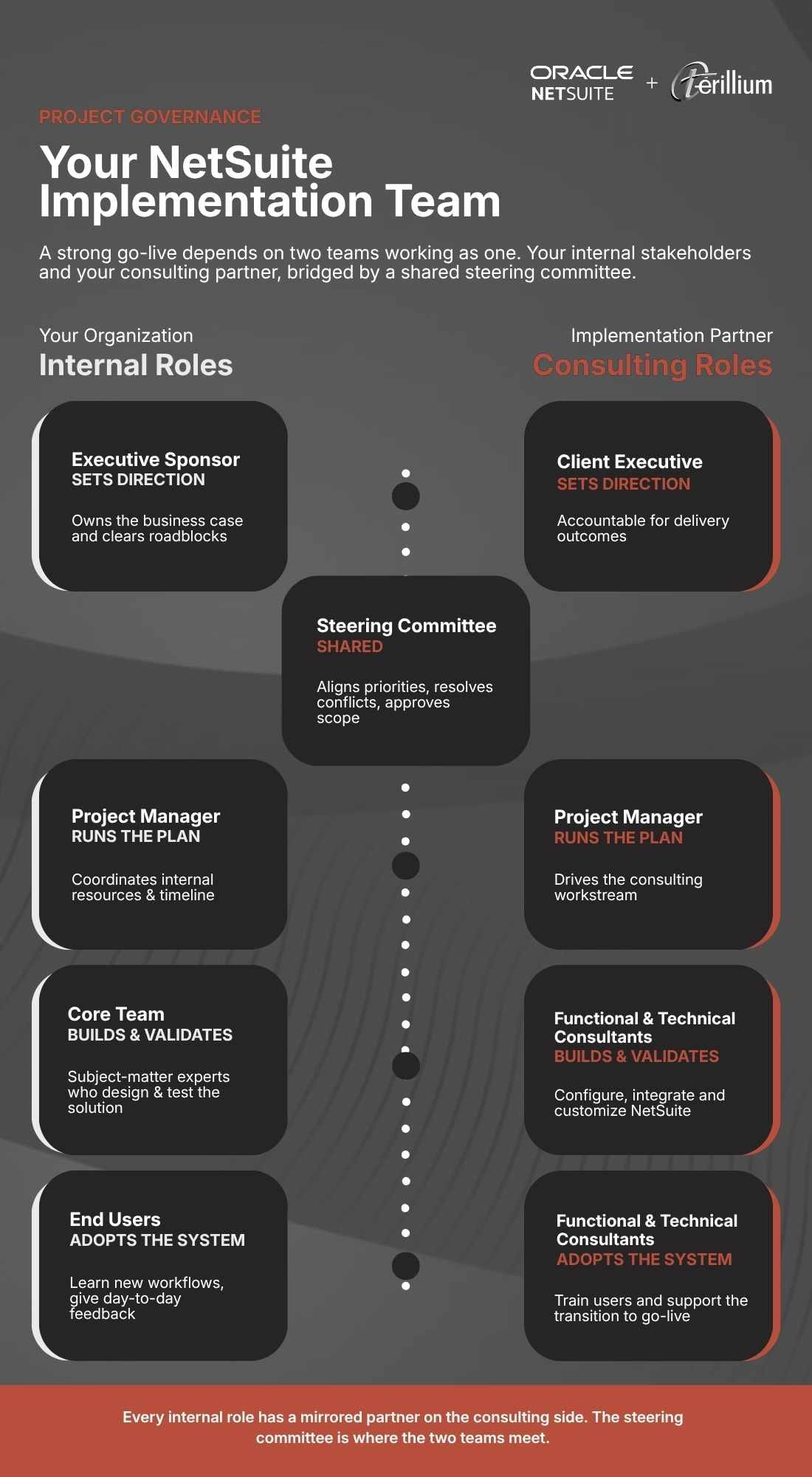
Your Internal Roles on the NetSuite Implementation Team
Who should be on your internal team?
Your internal implementation team should include executive leadership, project management, business process owners, and end users who understand your organization’s operations and can dedicate time to the project. Together, these stakeholders provide business knowledge, help make key decisions, validate solutions, and ensure successful user adoption.
Executive Sponsor
Every successful ERP project begins with executive commitment. The Executive Sponsor provides strategic direction, secures organizational support, and has the authority to make critical business decisions when priorities compete or roadblocks arise.
An engaged executive sponsor helps maintain momentum, reinforces the importance of the project across the organization, and ensures the implementation remains aligned with business objectives.
Steering Committee
The Steering Committee provides oversight throughout the implementation. Typically made up of senior business leaders, this group meets regularly to review project progress, evaluate risks, approve major decisions, and resolve issues that require executive input.
Internal Project Manager
Your internal Project Manager serves as the primary coordinator between your organization and the consulting team. They help organize resources, manage internal schedules, coordinate stakeholder participation, and ensure the business is prepared for each phase of the implementation.
A strong internal project manager keeps communication flowing and helps maintain accountability across departments.
Core Business Team
Often referred to as subject matter experts (SMEs), the Core Team includes business process owners from departments such as finance, operations, supply chain, manufacturing, sales, or customer service.
These team members work closely with the implementation consultants throughout the project by:
- Participating in discovery workshops
- Defining business requirements
- Reviewing proposed solutions
- Validating data
- Collaborating on user acceptance testing (UAT)
Because they understand day-to-day operations, their input ensures NetSuite is configured to support real business needs rather than theoretical processes.
End Users
End users are your employees who will use NetSuite frequently after go-live. While they may not participate throughout the entire project, involving them during testing, training, and change management activities significantly improves user adoption. Early engagement of end users helps build confidence in the new system while identifying usability issues before go-live.
Consulting Partner Roles on the NetSuite Implementation Team
Who should be on your consulting team?
Your NetSuite implementation partner brings the ERP expertise, implementation methodology, and NetSuite knowledge needed to successfully deliver the project. An experienced consulting team can lead you through the entire implementation from start to finish – providing guidance and best practices every step of the way.
Client Executive
The Client Executive provides oversight throughout the project and serves as the primary relationship manager between your organization and the consulting firm.
Their responsibilities typically include:
- Escalation management: stepping in when issues arise that the project team can’t resolve, especially around scope, budget, or stakeholder disagreements
- Client satisfaction: monitoring the status of the project and proactively addressing concerns before they become major problems.
- Project leadership: participating in Steering Committee meetings, providing executive updates, and helping make strategic decisions
Project Manager
The Project Manager (PM) is a crucial team member who is ultimately responsible for delivering the implementation successfully. The PM owns the day-to-day execution of the project. This includes:
- Project planning: creating and maintaining the project plan, timeline, milestones, and dependencies.
- Scope management: keeping the project within the agreed scope and managing change requests.
- Schedule management: tracking progress, identifying delays, and adjusting the plan as needed.
- Risk & issue management: maintaining risk and issue logs, facilitating resolution, and escalating when needed.
- Communication: running status meetings, distributing status reports, and keeping stakeholders informed.
Functional Consultants
A Functional Consultant is the person who translates your business processes into a working NetSuite solution. They spend the most time with your business users and are responsible for understanding how the business operates and configuring NetSuite to support it.
If the Project Manager is responsible for how the project gets delivered, the Functional Consultant is responsible for what gets built. This includes:
- Business process discovery: conducting workshops to understand current (“as-is”) and future (“to-be”) processes.
- Requirements gathering: documenting business requirements and identifying gaps.
- Solution design: recommending how NetSuite should be configured to meet business needs.
- Configuration: configuring NetSuite (forms, workflows, roles, saved searches, approvals, etc.).
- Documentation: producing solution designs, configuration documents, and process flows.
- Testing: developing test scripts, supporting UAT, and resolving defects.
- Training: training end users and creating training materials.
- Data validation: helping validate migrated data and ensure business readiness.
- Go-live support: assisting users during cutover and the hypercare period after go-live.
Technical Consultants
The Technical Consultant determines how to build anything that requires development or integration. Their goal is to extend NetSuite in a way that is smart and efficient while minimizing unnecessary customization. This could include:
- Custom development: writing SuiteScript to automate processes or add functionality.
- Integrations: building and maintaining integrations between NetSuite and other systems (CRM, WMS, eCommerce, payroll, EDI, etc.).
- Data migration: developing import scripts and migration tools, validating and transforming data.
- Custom records and fields: creating technical objects to support business requirements.
Building a NetSuite Implementation Team for a Small Business
Not every company has the resources to create the exact NetSuite implementation team outlined above, and that’s okay. For small businesses implementing NetSuite, one person may wear multiple hats throughout the project. For example, an owner might serve as the Executive Sponsor, while a controller or operations manager acts as both the Project Manager and subject matter expert.
The key isn’t the total headcount of the implementation team, it’s having the right people involved at the right time. Even in smaller organizations, it’s important to identify decision-makers, process owners, and employees who understand your day-to-day operations and can participate in workshops, testing, and training.
An experienced NetSuite implementation partner can help fill resource gaps. With the right balance of internal participation and external expertise, lean teams can achieve a successful NetSuite implementation.
The Best NetSuite Implementation Teams Collaborate for Success
One of the biggest misconceptions about ERP implementations is that the consulting partner implements the software while the client watches from the sidelines. In reality, successful projects are highly collaborative. Your team contributes knowledge specific to your business, while your implementation partner contributes NetSuite knowledge and implementation expertise. The right partner goes beyond configuring software. They become an extension of your team and help position your organization for long-term success.