


JD Edwards AI, Automation, and the Digital Platform Strategy
Anyone running JD Edwards right now is fielding the same questions from leadership: what are we doing about AI and where does automation fit into what we’re already doing. It came up repeatedly at Blueprint 4D, and it’s a fair thing to be thinking about.
Based on what Oracle’s product team is actively building, the direction is clearer than a lot of the noise around it would suggest.
What Is the JD Edwards Digital Platform?
Oracle uses the term “digital platform” to describe something that doesn’t have its own line item on a quote. You don’t buy it, install it separately, or configure it from scratch. It’s the layer that sits between your JD Edwards applications and the infrastructure underneath, and it’s what makes the system extensible without requiring you to start over every time something changes.
That includes Orchestrator, notifications, the extensibility framework, form extensions, widgets, watchlists, and the integration and API capabilities that connect JD Edwards to the world outside it. If you’ve used any of those things, you’ve been inside the digital platform without necessarily calling it that.
These capabilities have also built on each other over time in ways that weren’t necessarily planned from the start. Queries gave way to watchlists, watchlists connected to widgets, and Orchestrator grew into the backbone of enterprise automation. Form extensions, now including the Power Edit Form as of the 26.2 release, keep adding to that without requiring customization.
Does Oracle Have an AI Strategy for JD Edwards?
This is probably the question JD Edwards ERP customers are asking most right now, so it’s worth being direct about what Oracle said.
Oracle is focused on making JD Edwards and Oracle AI more open and more accessible to the AI tools and platforms you want to use, through APIs, through Orchestrator, and through a REST-based discovery service that exposes your orchestrations and their inputs in a format that AI models can actually work with.
The ask from Oracle’s product team is specific: if you’re trying to connect JD Edwards data to an AI model or an MCP server and something isn’t working because information is missing from the API, tell them. That’s the kind of enhancement request they can act on. What they’re building is an open architecture. What you bring to it is up to you.
The partners and customers who are furthest along are already using that openness and building on it. JD Edwards Release 27 is expected to launch with even more AI capabilities and features.
Orchestrator Goes Further Than You Might Think
Most JD Edwards teams using Orchestrator are pointing it at business processes. What’s worth paying attention to is what happens as Oracle continues to web-enable traditional system administration and development functions.
Once those functions live on a web interface, they become orchestratable. That means the same JD Edwards Orchestrator framework you’re already using for business process automation can reach into package builds, deployments, and package promotion. If you’ve ever had to wait on a package build to get a change into production, that’s a meaningful shift.
The other piece is system-level data. Orchestrator isn’t limited to application data, it can pull from system tables too. Object usage tracking, OMW status codes mapped to custom process models with metrics overlaid on top. Things that were previously difficult to surface are now accessible through the same orchestration framework your team already knows.
Building Around What’s Already Working
Not every organization is in the same place with JD Edwards, and Oracle’s digital platform strategy doesn’t assume they are. Automation, integration, and user experience improvements can happen in phases, and building a JD Edwards technology roadmap around those priorities is how most organizations approach it. AI enablement with JD Edwards fits into that same approach rather than requiring a separate platform decision.
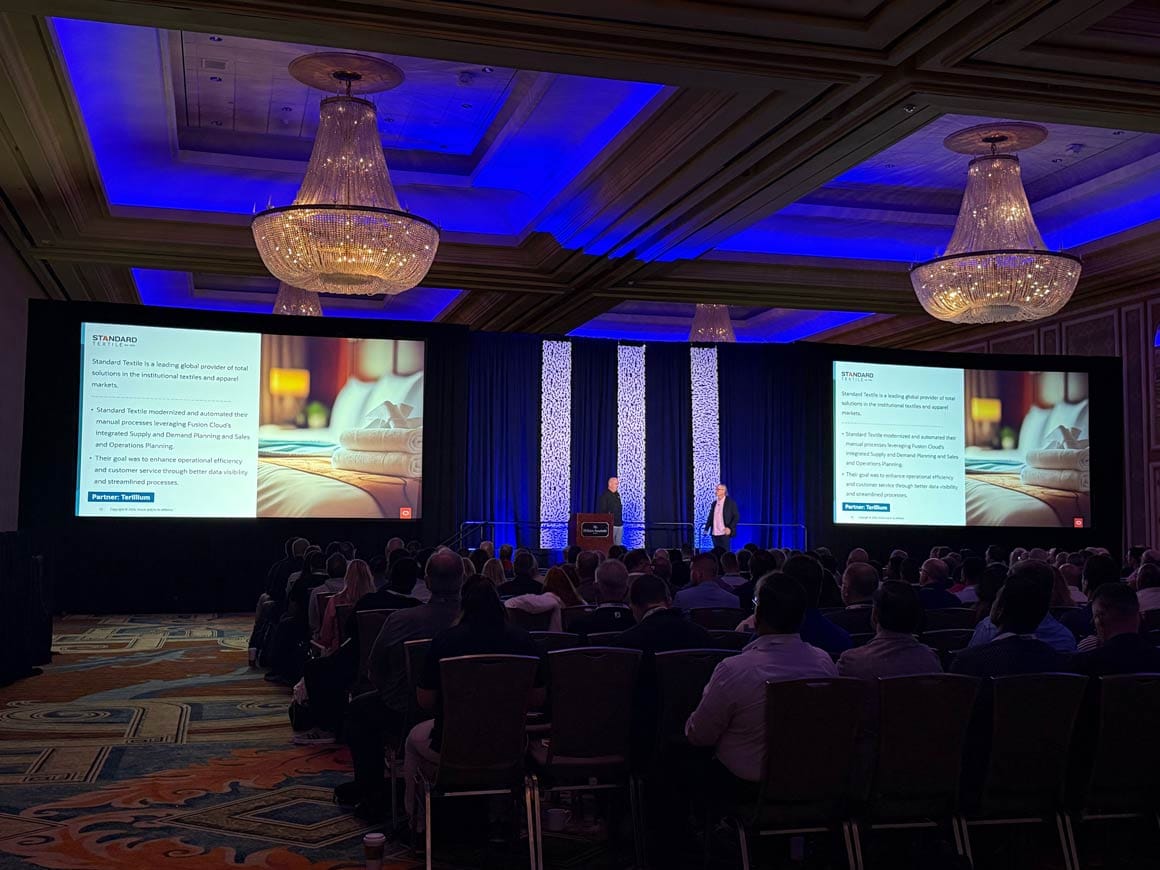
Standard Textile runs JD Edwards EnterpriseOne 9.2 and had no interest in replacing it. What they needed was better forecasting, more visibility across planning teams, and less manual work in their supply chain process.
Working with Terillium, they implemented Oracle Fusion Supply and Demand Planning and S&OP, integrated with their existing JD Edwards environment through Oracle’s prebuilt connectors. JD Edwards stayed central. Fusion extended what it could do.
The results:
- Improvement in forecast accuracy
- Increase in order fulfillment
- Increase in inventory turns
- Reduction in expedited freight costs
- Reduction in inventory levels
The supply chain outcomes speak for themselves. Read the full Standard Textile case study.

Is Oracle Still Investing in JD Edwards?
Not every organization is in the same place with JD Edwards, and Oracle’s digital pOracle’s product team put it simply at Blueprint 4D. The goal is keeping your JD Edwards system effective and relevant in an ever-changing technology landscape. Four to eight enhancements per quarter, an active roadmap, and a clear direction on automation, AI enablement, and extensibility backs that up. The organizations getting the most out of it tend to be the ones who know what the platform can do and are making deliberate use of it.
If you’re working through a JD Edwards upgrade or just trying to get a clearer picture of where your environment is headed, we’re happy to talk through it. Reach out to our team.